Independent sourcing partner

Fiber optic power meter price quotes follow wavelength and kit scope

LinkScope Sourcing 04 collects the wavelengths, the power range in dBm, the quantity, and the destination, then asks factories to price that same fiber optic power meter scope. The desk does not publish a shelf price, claim stock, or stand in as the instrument maker.

  • Calibrated wavelengths
  • dBm range
  • Adapter set
  • Calibration file
Request Factory Quotes Review inquiry options
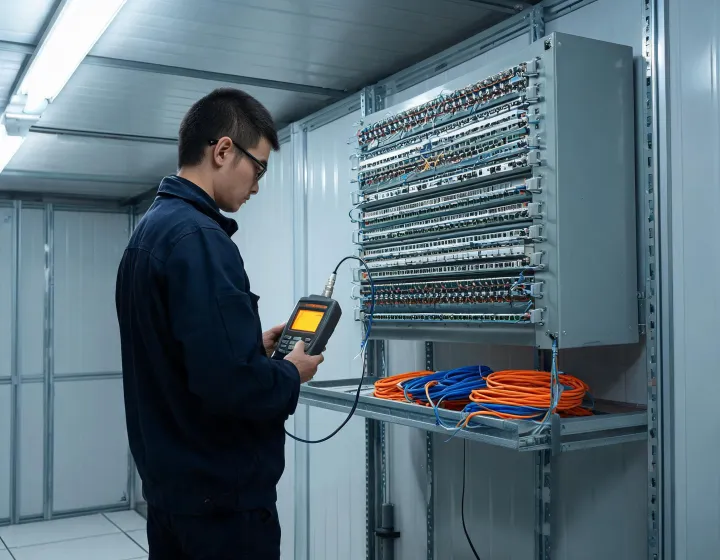
Technician reading a handheld optical power meter at a fiber patch panel

What a usable power-meter quote has to carry

A fiber optic power meter price is comparable only after the detector job is written down. Absolute power in dBm is 10 log10 of the ratio of measured power to 1 mW. A relative dB reading is a different display mode. Buyers who leave both modes unnamed receive quotes that cannot be lined up.

1. Wavelength set

Name the calibrated points the procedure uses. Common request lists include 850 nm, 1300 nm, 1310 nm, 1490 nm, 1550 nm, and 1625 nm. An InGaAs detector is often specified for the 1310 nm to 1550 nm window. A silicon detector is a separate question for 850 nm multimode work. Ask which points are calibrated, not merely selectable.

2. Power range and accuracy class

Ask the datasheet for the range in dBm and the measurement accuracy at a named wavelength and temperature, for example 1310 nm at 23 °C. A standard detector and a high-power detector are different commercial lines. A +26 dBm CATV-style upper end is not implied by a meter whose sheet stops near +10 dBm. Do not copy a ±0.2 dB class from a different model.

3. Connector and launch

State FC, SC, ST, LC, a 2.5 mm universal interface, or a 1.25 mm interface. Interchangeable adapters are accessory lines. Insertion loss of the link under test depends on the reference method. One-cord and two-cord references answer different questions. The meter itself does not clean a ferrule.

4. Evidence and exclusions

Calibration traceability means a certificate tied to the serial number and an interval the buyer accepts, often questioned as 12 months from a stated date. Light source, visual fault locator, case, and patch cords sit inside or outside the price. Software for storing readings is a separate line when it is licensed.

Procurement scenario: central-office loss check

Background: a US carrier crew measures absolute power at 1310 nm and 1550 nm on single-mode jumpers in a central office, destination Georgia, quantity 12 meters. Process: the brief fixes those two wavelengths, a standard dBm range rather than a +26 dBm CATV detector, SC adapters, and a certificate dated at shipment. Result: one factory priced the meter body only, so the landed comparison waited until adapters and the certificate fee were either both in or both out.

Procurement scenario: multimode campus kit

Background: a campus contractor needs meters for 850 nm and 1300 nm multimode links before a 2026 cutover, quantity 30, destination Ohio. Process: the RFQ asks whether the detector is specified for those wavelengths, which 2.5 mm adapters ship in the case, and whether a companion source is included. Result: replies that listed only 1550 nm stayed in a deviation column instead of being averaged into one number.

Buyer roles that change the meter brief

Telecom procurement

The buyer owns quantity, Incoterm, currency, and whether the quote is per unit or whole order. Optical budget and receiver sensitivity belong on the link design, not as a meter slogan. The meter RFQ asks which dBm window the crew will actually read.

Optical engineers

Engineers name wavelength, fiber mode, and the reference method for insertion loss. Transmit power of a transmitter is measured at the meter only when the detector range and the connector match that port. Dispersion is not a handheld power-meter result.

Field crews

Ingress protection, battery type, and adapter loss matter more than a bench warm-up note. A 650 nm visual fault locator shows a break to the eye. It is not a calibrated dBm reading and should be a separate BOM line if the crew wants one.

Quality reviewers

Reviewers ask for the current datasheet, the calibration certificate, and any supplier ISO 9001 file that the proposed factory actually attaches. An NRTL mark is a question for the exact model. This desk does not issue either document.

Related reading: fiber optic power meter price procurement brief. Companion scope sits on the fiber optic power meter with page.

Trade-off: single-mode calibration versus multimode calibration

Single-mode work usually asks for 1310 nm and 1550 nm, sometimes 1490 nm or 1625 nm, on a plant described by the project edition of an ITU-T single-mode fibre recommendation. The industry research record points at the ITU-T recommendations catalog, accessed 2026-10-27, as a question source only. Multimode work usually asks for 850 nm and 1300 nm. A meter calibrated on one pair does not automatically cover the other. LinkScope Sourcing 04 records the plant type as a requirement. It does not grade either plant as preferable.

Trade-off: new meter versus refurbished meter

A new meter may arrive with unused adapters and a certificate dated at dispatch. A refurbished meter may fit a legacy procedure if condition, remaining calibration months, and missing adapters are listed. Freight and a fresh certificate can erase an apparent body-price gap, so both totals stay visible.

Questions to close before a factory number is usable

Which quantity unit should the quote use?

Pieces, with a separate line if a kit includes a source or adapters. A 6-piece pilot and a 200-piece rollout are different commercial answers. Say whether spare adapters are included per unit.

Which destination and trade term apply?

Name the US state or the export city, and whether the request is EXW, FCA, or another Incoterm the buyer wants compared. Freight, duties, and brokerage stay outside the instrument price until someone prices them.

What timing is a request, not a fixed interval?

Write the week the crew needs meters on the bench. Factories reply with their own lead time. This desk does not publish a standing delivery interval.

What evidence is mandatory on the first reply?

Current datasheet, calibrated wavelength list, power range, connector list, and the calibration statement tied to the proposed model. A family photo is not that file. Host compatibility with a named OTDR or light source is a separate yes or no.

Where does this desk stop?

LinkScope Sourcing 04 does not certify optical budget, return loss, or insertion loss for a link. Those results depend on the plant, the reference method, and the instruments used on site. The desk also does not claim FCC equipment authorization for a passive power meter.
Compare factory quotes on one meter sheet

Send the wavelength list, the dBm range, the adapter set, the quantity, and the destination. Optional budget needs a currency and a per-unit or whole-order basis. Mark high-end, mid-range, budget, or undecided only as the buying preference you want recorded.

Three limits sit on every comparison. A power meter does not report distance to a break. A wavelength missing from the calibration list is an open deviation. A universal adapter does not prove end-face condition.