Field path, written as a purchase brief

UTDR fiber optic power meter searches need a function split

A utdr fiber optic power meter query often mixes a trace instrument with a power meter. LinkScope Sourcing 04 does not treat UTDR as a brand this desk represents. The buyer writes whether the job is an OTDR-style distance trace, an absolute dBm reading, or both. Each function is a separate quote line until one datasheet shows both on the same model.

Request Factory Quotes
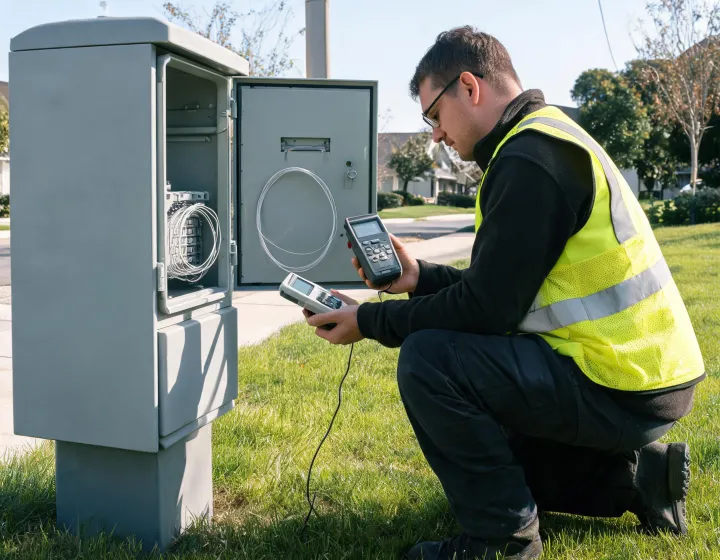
Outside-plant technician with a fiber test set at a pedestal

Interfaces the field path has to name

Outside plant, single-mode

Crews often ask for 1310 nm and 1550 nm, sometimes 1625 nm for a live-fiber check the procedure allows. Reach of the span is a design number in kilometres. The power meter reads power at the detector. It does not compute span length. State the connector at the pedestal, often SC or FC.

Data hall, short links

Multimode 850 nm and single-mode 1310 nm can both appear in one hall. Port speed and transceiver reach stay on the transceiver RFQ. The meter brief only needs the wavelength and the connector at the patch panel the crew will touch.

PON activation checks

Some procedures read 1490 nm downstream and 1310 nm upstream at an ont or olt port. Optical budget is calculated by the designer from transmit power, receiver sensitivity, and loss. Ask the meter quote only for the wavelengths and the dBm window those ports can present, including whether a high-power detector is required.

Contractor tool bags

Ingress protection, battery count, and a 2.5 mm plus 1.25 mm adapter pair matter when the same meter visits many closets. A kit case is optional. Write it in if the truck standard requires one.

Method comparison for the same search phrase

Instrument roleWhat it can reportWhat it does not reportQuote line
Optical power meterAbsolute power in dBm or watts at calibrated wavelengthsDistance to a break, return lossDetector model and range
Light sourceStable launch at named wavelengths for a loss testA pass or fail by itselfSource model and wavelengths
OTDR-style traceEvent table and distance, within that model resolutionA calibrated absolute power at every eventTrace unit, wavelengths, pulse settings to confirm
650 nm VFLVisible glow for a nearby break or benddBm, insertion lossPen, if the crew wants one

Trade-off: single-mode plant versus multimode plant

Single-mode arguments fit longer outside-plant spans when the fibre recommendation and the optics match. The ITU-T recommendations catalog accessed 2026-10-27 is the question source this industry file records. It does not certify a meter. Multimode arguments fit shorter data-hall links at 850 nm when the fibre and the source are both multimode. Buying one meter for both plants requires both wavelength sets on the calibration list. Otherwise the RFQ should split the tools.

Trade-off: OEM-named kit versus a compatible pair

Some procedures name a maker because the adapter list and the calibration steps are easier to audit. Others accept a compatible meter and source when measurement accuracy, wavelengths, and connectors are written for those exact units. LinkScope Sourcing 04 records the choice as a deviation. It does not score either side, and a preference for high-end, mid-range, or budget is still only a buyer preference.

Project questions before the field kit is priced

What is the intended use on this project?

Absolute power at a patch panel, insertion loss with a source, a distance trace, or a visible check. Write one primary use. Secondary uses become extra lines. A utdr fiber optic power meter phrase is not specific enough to send to a factory.

Which documents and delivery stages apply?

Datasheet before order, certificate at shipment, and incoming check of wavelength settings when the cartons arrive. Name who accepts a deviation. Site constraints such as live fibre, pedestal access, or a 2026 maintenance window belong in the timing note.

Which environment limits the tool?

Operating temperature and ingress protection are datasheet fields. A bench meter and a pedestal meter can share a wavelength and still differ on sealing. Ask for the stated range rather than assuming an outdoor rating.

What stays outside this instrument?

Dispersion, return loss, VSWR, and impedance are not power-meter outputs. Data rate of the traffic is not measured by the detector. If the project needs those results, open a different equipment brief.

Turn the field path into a factory quote

State the project use, the wavelengths, the quantity, the US destination, and the week the crew needs the tools. LinkScope Sourcing 04 will ask factories to answer on that sheet. The desk does not publish a distance rating or a loss limit for your plant.

Three boundaries travel with the request. Trace distance is an OTDR-model question. A missing calibration wavelength is a deviation. Live-fibre work needs the procedure the buyer already uses, not a claim from this page.